
Running payroll is one of the first real tests a new business owner faces. Long before most businesses hire a human resources (HR) person or buy payroll software, they search Google for guidance on how to pay employees. That activity is a real-time map of where small businesses hit roadblocks, so we pulled the numbers.
What you’ll learn
What you’ll learn
Key findings
- Searches about how to run payroll yourself total more than 91,000 per year in the US, led by “how to do payroll” (2,400 per month).
- The paper paycheck is not dead: queries about where to cash a payroll check (“who cashes payroll checks near me,” “does Walmart cash payroll checks”) run about 35,000 per year.
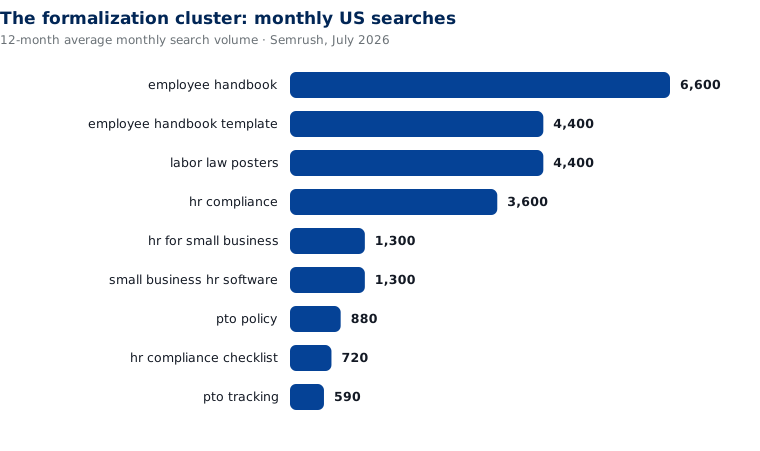
- The formalization cluster is the giant: employee handbooks, HR compliance, labor law posters, and PTO policy draw roughly 285,000 searches a year.
- Paid family leave is the single biggest compliance topic we measured: about 374,000 searches a year across the national term and state variants, with “paid family leave California” alone at 8,100 per month.
- A brand-new anxiety appeared in 2026: “is QuickBooks discontinuing payroll service” now draws about 2,900 searches a month, a query with essentially no search history before this year.
Let’s dig into what the data reveals about how owners are actually handling pay, HR, and compliance.
Doing payroll by hand is still a mainstream choice
The “do it yourself” cluster (how to do payroll, payroll spreadsheet templates, running payroll in Excel, paying your first employee) adds up to about 7,600 searches every month.
Two details stand out:
- First, “payroll for one employee” gets 480 searches a month, and clicks on that phrase cost advertisers about $68 each, the highest in our set. The market knows a business owner Googling that phrase is about to make a decision.
- Second, “how to do payroll yourself” peaks in the new year and around tax season, exactly when the cost of getting it wrong comes due.

The paper-check economy
Employees, not employers, are the tell here. “Who cashes payroll checks near me” (880 per month), “does Walmart cash payroll checks” (720), “where can I cash a payroll check” (720), and “can you cash a payroll check at Walmart” (590) add up to roughly 35,000 searches a year from workers holding a physical check without an obvious place to deposit it. Behind many of those checks is a small employer still running payroll by hand.

Formalizing HR is a 285,000-search problem
Business owners are not searching for hypotheticals. They’re researching resources they can put to use: the handbook, the poster, and the policy. “Employee handbook” (6,600 per month) and “employee handbook template” (4,400) are among the most-searched HR terms in the country, alongside “HR compliance” (3,600), “labor law posters” (4,400), and “PTO policy” (880). Each one marks the moment when informal management is no longer enough.
Compliance is now a state-by-state question
The paid family leave cluster is the largest single topic in our data: about 374,000 searches a year. The national term draws 18,100 monthly searches, but the state variants tell the real story: California at 8,100 per month, New York at 1,900, Washington at 1,600, Massachusetts at 720, Oregon at 480. As more states launch their own programs, an employer’s compliance question is no longer “what does federal law say.” It is “what does my state say,” multiplied by every state where they have a worksite. Our guide to paid family leave rules by state tracks each program.

The QuickBooks question
The most striking single data point in the pull: “is QuickBooks discontinuing payroll service” now runs about 2,900 searches a month, and the query barely existed before 2026. “Does QuickBooks do payroll” (1,000 per month) is climbing at the same time. The takeaway? A meaningful slice of the market is unsure whether its current payroll setup will still exist next year — and is asking Google rather than a vendor.

What to do about it
Search data is demand data. It says small businesses do not wake up wanting payroll software. They wake up wanting an answer: how do I pay my first employee, what goes in a handbook, does my state have paid leave, and is my current provider going away? If the questions above sound familiar, three moves cover most of the ground.

Built for growing businesses
“OnPay is a very simple and easy-to-use HR and payroll company that works well for my small and growing business. The pricing is great, and the setup is simple.”
— Joshua Cartagenova, Calyx Staffing, Inc.
- Pick the pain that costs the most: Payroll measured in hours, a missing handbook, a state you just hired in. Fix the expensive one first.
- Don’t wait for January: Any quarter boundary gives a clean cutover, and a mid-year move means setup happens while support queues are short and nobody is racing the W-2 clock.
- Integrate rather than multiply: One platform where payroll, HR, and benefits share one employee record beats adding another point tool.
Coming soon: The January Effect. OnPay research shows when small businesses actually switch payroll, what the December wave looks like, and what waiting for January costs.
Methodology
Search volume figures are 12-month average US monthly search volumes from Semrush, retrieved July 2026. Cluster totals sum the listed queries only and therefore understate true topic demand, since long-tail variants are excluded. Cost-per-click figures are Semrush advertiser averages for the same period.
Spend your hours on the work only you can do. See how OnPay puts payroll, HR, and benefits in one place, with the filings handled.

Jon Davis is the Sr. Content Marketing Manager at OnPay. He has over 15 years of experience writing for small and growing businesses. Jon lives and works in Atlanta.